Your agents, your models, your devices, your app. Or ours.
AnyBio is the layer health AI runs on. Bring your agents, devices and patient app or use ours; bring your model or run an open one. Either way the same rails capture the signal, check every patient-facing output before it sends, and record what was proposed against what actually went out.
Four things have to run somewhere. None of them have to be ours.
Most platforms are neutral on one axis and captive on the rest. Here is every axis, with what you can bring and what we can supply, stated plainly enough to check.
Agents
YOURSYou author the behavior: the prompt, the trigger, the data it sees, and the rules it cannot break. There is nothing to deploy and no second compliance environment to run. BAAs with the model providers are already executed, every patient-facing output is checked against your rules before it sends, and escalation follows the rules you set.
OURSAdherence outreach that reaches only the patients drifting off pace, and symptom capture when a reading lands out of range. Configured against your protocols, under your clinicians' oversight.
Models
YOURSYour validated algorithm, SaMD or DSP lives in your own model registry: versioned, content-hashed on upload, enabled or disabled per program, and carried through to the record, so every observation says which version produced it. It runs inside our boundary rather than pulling data into yours, so the patient data never reaches your infrastructure.
OURSNo model of our own, deliberately. If you have one, it runs here. If you don't, an open model runs here the same way, because the registry doesn't care who wrote it. What we won't do is author a proprietary model, because that is how a layer quietly becomes a competitor to the partners on it.
Devices
YOURSAny BLE device via the SDK, embedded where your Bluetooth code already runs. Patent-pending dynamic provisioning brings a new device online without hardcoding its protocol into an app binary or shipping an app-store update.
OURSA catalog of 60+ FDA-cleared cellular devices through our network partners, shipped to your patients and captured onto the same rails.
App
YOURSThe SDK goes into the app you already ship, so your patients or participants are not asked to install a second one.
OURSThe AnyBio app, for programs that would rather not build or maintain a patient-facing surface at all.
Neutrality is a structural claim, so it should be checkable rather than asserted. The models row is the check. We built a versioned, content-hashed registry for other people's models and shipped none of our own, which is a strange thing to do unless the neutrality is real. A company whose models are the product cannot write that row, because its own roadmap depends on the answer being different.
If anyone's AI can run here, what stops it saying the wrong thing?
This does, at runtime rather than afterwards. Most oversight in this market is post-hoc: a care manager reads what the AI already sent. Here the output is evaluated against your program's policy before it goes anywhere, and can be held for a person while it is still a draft. One decision, from what the agent proposed to what was written down.
“Your last three readings are above your target range. You should increase your dose to 10mg and recheck in the morning.”
The draft carries clinical direction, which this program's policy does not permit an agent to deliver. On a violation, this policy holds the message and raises it to a person.
Nothing model-written. The draft was never sent.
The on-call clinician's review queue, with the original draft attached and the reason for the hold alongside it. A licensed human makes the call, and the patient hears from them rather than from the agent.
- Decision
- block_and_review
- Original content
- Retained in full
- Reason
- Prohibited claim detected
- Reviewer
- Routed, pending
A representative decision on illustrative content, not live patient traffic. For a patient message the platform makes one of three decisions: allow, hold for a person (the block and review shown here), or block when the patient has not consented on the channel. A stopped patient draft is written again once with the gate's reasons before it is held. Allow sends the message as drafted, which is the common case; this page shows a hold because it is the case people ask about.
A governed answer is also the same answer tomorrow.
Governance usually means one thing: what a model is allowed to say. That is the section above, and it is most of what the market means by the word. It says nothing about whether the number was right, or whether you get the same one next week.
This is a real failure and a quiet one. Ask a health assistant how often you hit your target, ask again in slightly different words, and you can get a different figure, because the model changed what it counted and said so to nobody. Both answers arrive with the same confidence.
Scores, averages, thresholds and windows are computed in code before an agent sees them. What reaches the model is a finished value with its unit and its clinical code already attached. Ask twice and you get the same number, because the number never came from the model.
Every contribution to a score arrives itemized, each with the reason it counted. What was included is recorded rather than inferred, so a rule cannot be silently added or dropped between one answer and the next.
The model still writes the sentence, so it can still describe a correct number badly. Templated messages are not exposed to that at all, because the words come from code. What we will not tell you is that a language model cannot be wrong; what we can tell you is that it is not the thing doing your math.
You don't run your assistant here. It runs us.
The obvious question about a neutral layer is whether your AI can run on it. The more useful one is the other way round. AnyBio exposes an MCP server, so an assistant your team already uses can author a monitoring program directly: describe the population and the signals, and it creates the profile, adds the agents, configures the triggers, validates the spec, and hands back an enrollment link.
The program it builds runs under exactly the same governance as one a clinician configures by hand. Which is the point: the authoring surface is open, and the rules underneath it are not negotiable by whoever is doing the authoring.
One rail underneath all four.
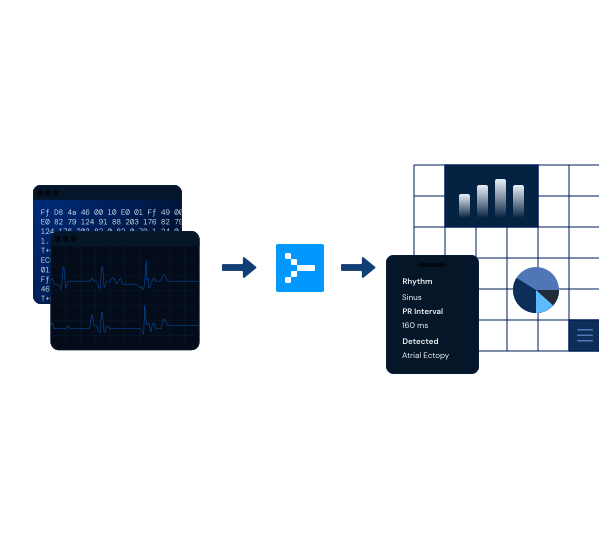
Whichever combination you bring, the path is the same. Signal is captured at the source and carries its provenance forward. Anything that needs to run on it runs inside the governed envelope, on our infrastructure rather than yours, so you never take custody of the patient data. Output lands as an EHR-ready FHIR observation in the system your team already works in. The decision record sits alongside it, which is what makes any of this auditable a year later.

YOUR DEVICES


CLINICAL SYSTEMS
SIGNAL CAPTURED
GOVERNED ENVIRONMENT
YOURS OR OURS RUNS IN-PLACE
CHECKED BEFORE IT SENDS
EHR-READY FHIR OUT
YOUR DEVICES
CLINICAL SYSTEMS
Pick the axis you came for.
Bring what you have. We supply the rest.
Tell us which axes you already own and which you would rather not build. We will scope it against your program, concretely, and say plainly where the rails are ready and where they are not.