Your health AI is only as good as what it can see.
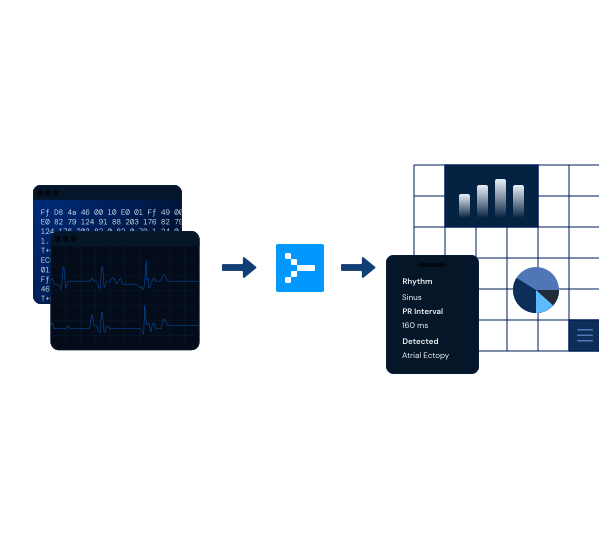
AnyBio is the layer between what the body is doing and what software says about it. Capture from the devices patients actually use, a check on every patient-facing message before it sends, delivery into the record, and the trail that proves it. We author no model. Bring yours.
 SOC 2 Type II
 HIPAA Compliant
 FHIR-native
 Patent Pending
Care keeps moving into the time between visits. Hiring is not how you follow it there.
Monitoring produces far more signal than any team can work. In published research, most physiological-monitor alerts are non-actionable, so staff burn out on false alarms while real deterioration hides in the noise. Adding coordinators does not fix that, because the volume scales with the population and the budget does not.
The answer is automation, and almost nobody in this category has shipped it to the patient. Every platform that added AI added it for the care team: transcription, summarization, care-plan drafts. The AI stops at the clinician's desk, because putting it in front of a patient is a compliance program rather than a feature, and the liability lands on the provider.
The layer that makes it deployable.
- Every output an agent would send to a patient is checked against your program's rules before it sends.
- A record of what was proposed and what actually went out.
- Your agents or ours, on any device that qualifies.
- Signal captured at the source and delivered into your record with its provenance.
- Your clinicians (or a cleared algorithm running on our rails) make the determination.
Four properties that make patient-facing AI deployable.

Neutral
Your agents or ours, on any device that qualifies. We don't ship a competing care model and we don't privilege a device maker, so nothing you build here ends up competing with its own landlord.
Your agents or ours.

Grounded
It starts at the sensor, on signal from the devices that capture what happens between visits, and carries that signal all the way into the record with its source attached at every step.
It starts at the sensor.

Governed
Every output an agent would send to a patient is checked against your program's rules before it sends. Allowed, or held for a person, with only your clinic's own words reaching the patient while it waits. Models are reached only under BAA.
Checked before it sends.

Accountable
What the model proposed, what actually went out, and where every value came from, all recorded and deliverable into your record as structured FHIR.
Proposed, sent, recorded.
Captured, governed, and delivered. End to end.
Signal at the source.
A device's signal is captured at the source through a secure profile and one SDK, made meaningful, and any algorithm or model that needs to run on it runs inside a governed envelope, on our infrastructure, never on yours.
Checked before it reaches anyone.
Every output an agent would send to a patient is checked against your program's rules first, then allowed, or held for a clinician while the patient hears only what your clinic wrote in advance. The decision is recorded alongside what was originally proposed, and models are reached only under BAA.
Into the system your team already works in.
The result lands where the work already happens: the EHR, the care management platform, or whatever your team actually lives in. FHIR-native by default, HL7v2 where that is the existing path, and anything else scoped to your workflow rather than the other way round. A first program of a few hundred patients and a full deployment of tens of thousands run on the same rails.
Not a dashboard. Output your systems can already read.
Every step above produces something a clinician, a record system, or an auditor can act on. These are the shapes it comes out in.
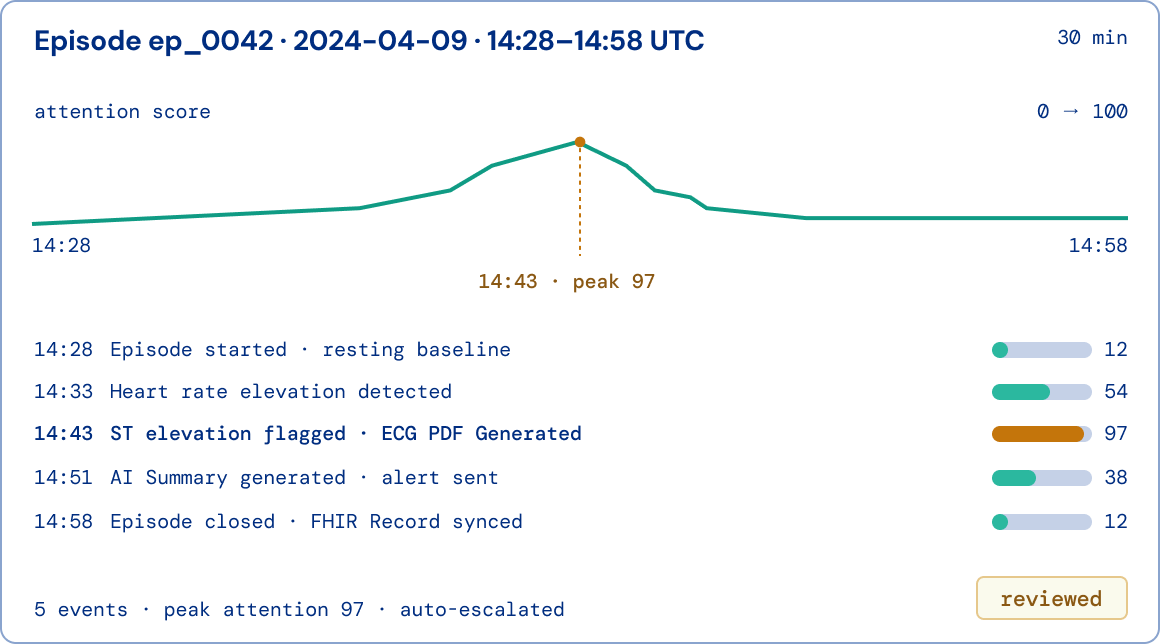
The patients who need you, scored and in order
Continuous signal is organised into episodes rather than a stream, and each one carries an attention score. Your team works a ranked queue instead of a feed, which is what makes a larger panel possible without more staff.
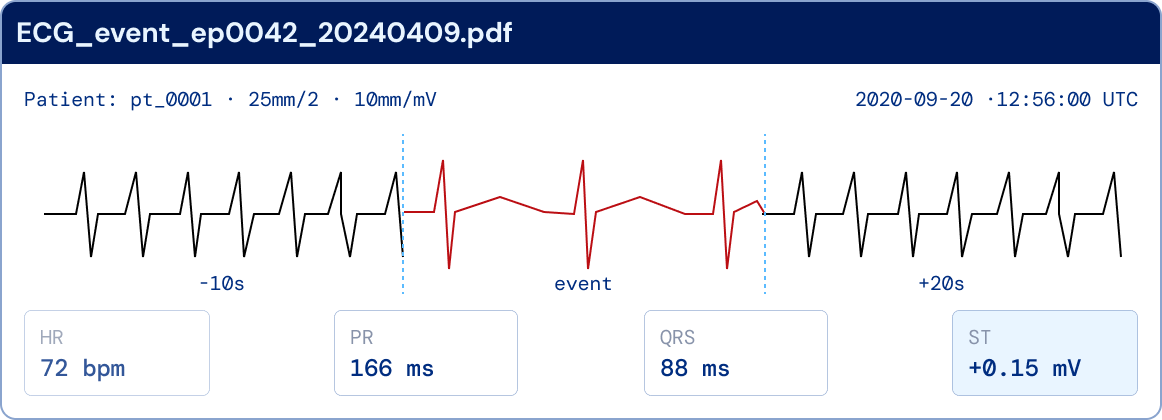
The strip, with the context around it
When something is flagged, the waveform comes out as a PDF with the minutes either side of the event and the intervals measured, so a clinician sees what happened rather than that something happened.
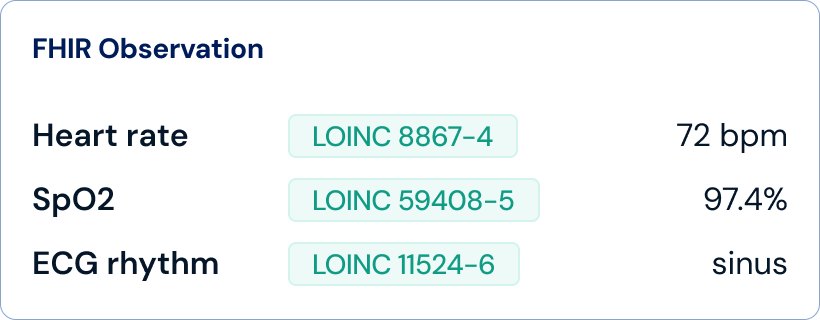
LOINC-coded, and ready for the record
Values arrive as FHIR R4 Observations with the codes already attached, so they drop into a compliant record system without a mapping layer in between.
Rendered from real output shapes on representative data, not from a live patient.
The constraint is people. Software is not.
In every one of these programs the work scales per patient and the staff does not. That is the whole economic problem, and it is the one thing an agent changes: it converts a cost that grows with every enrollment into one that does not.
Time to first revenue
The regulated foundation under a health product is not the product, and every month spent building it is a month of not selling. Shipping on rails that already carry SOC 2 Type II, executed model-provider BAAs and PHI custody moves your first revenue forward by however long that build would have taken.
It also answers the security review you would otherwise fail, which is where most health products actually stall.
The staffing line has a date on it
From January 2027, CMS proposes that billable monitoring minutes come from the billing practice's own employees rather than an outsourced vendor's. A platform that resells contracted clinical staff loses that line on a date already on the calendar. The software line is untouched, and what a platform sells after that is what its software does with its customers' own clinical minutes.
Governed agents inside the programs you run are that differentiation: the non-clinical chase moves to software so your clients' clinicians stay at the top of their license, and they work across whatever devices your provider clients already deployed.
The integration a site will decline a study over
A one-study integration costs a site roughly what a whole-organization integration costs. Sites respond by declining studies or degrading the design to avoid the work, which shows up as slower enrollment and a smaller pool of willing sites.
Removing that build is not a cost saving. It is the difference between a site saying yes and saying no.
Twenty minutes, every patient, every month
Medicare's rate stack pays up to roughly $150 per patient per month for a consistently billed remote monitoring program. The median program realizes about a third of that. The difference is minutes: the clinical-staff code pays only after twenty minutes of work per patient per month, and panels outgrow the minutes long before they outgrow the codes.
We don't print a staffing multiplier. We measure one: patients per clinician at the billable threshold, instrumented from your first patient.
Reimbursement figures are 2026 national averages and vary by locality; the realized-median figure is our own analysis of published CMS claims data. Which code funds which part of a program: the code-by-code breakdown.
Four things you can buy from us, plainly.
Your own health AI, on our rails
Author the behavior and we run it: the prompt, the trigger, the data it sees, the rules it cannot break. Nothing to deploy. Bring a validated algorithm or model and that runs here too, versioned and hashed. BAAs with the model providers already executed, every patient-facing output checked before it sends, and a record of what was proposed next to what actually went out.
See how it worksGoverned agents across the programs you run
For platforms operating monitoring on behalf of provider clients: white-label the same governed agents under your own brand. One webhook on the measurements you already collect, then symptom outreach, adherence and triage run program by program, each under its own rules and audit trail. Add it to your platform as a SKU your clients can turn on. You keep the workflow and the customer relationship; the layer underneath governs what software may say to a patient, and keeps the record of it.
See RPM AI automationRemote capture for your study
The participants who never come in. The SDK goes into your participant app, or they use ours, capturing from a catalog of 60+ FDA-cleared cellular devices plus any BLE sensor your protocol calls for. Every value carries its provenance. The same agents keep participants on track between visits. You keep your protocol, your sponsor and the study platform you already run.
Talk through your studyAgents on the monitoring you already run
Symptom outreach when a reading lands out of range. Adherence protocols that reach only the patients drifting off pace. The interventions are established clinical practice; what's new is that they run without adding headcount. Configured against your protocols, under your clinicians' oversight, neutral across the devices already deployed.
For your care teamEach starts as a working session: we scope it against your program, concretely. If you don't have monitoring in place yet, that's its own conversation: devices from a catalog of 60+ FDA-cleared cellular options, shipped and captured onto the same rails. And because the rails already run in production, the infrastructure side of your timeline is days, not months; there's nothing left to build.
The buyers differ. The job does not: reach the people who aren't in front of you, safely, without staffing for it.


Building the technology rather than deploying it? Device makers and validated algorithm, SaMD and DSP companies run on the same rails to reach the teams above: put your device or your model on them.
One SDK in. Piped right into where you work.
Epic delivery is proven against Epic's developer sandbox. EHR-ready FHIR R4 and HL7v2 delivery are the live paths into record systems today.

“AnyBio gave us the foundation to build a skin intelligence system without spending months on infrastructure. We went from raw data to real predictions in weeks.”
Rumeesa Rais, MSc
Founder & CEO, Reflect
Your agents or ours. We make them deployable.
Your clinicians make the decisions. We carry the signal, check every output before it reaches a patient, and record what was proposed against what was sent.