The teams deploying care are standardizing on neutral rails. Put your device or your model on them.
AnyBio is the layer clinical teams, care programs and study sites run their health AI on. Getting your device or your validated model onto it is how you reach them and their patients, compliantly, without building the regulated path yourself.
What you built is the hard part you already solved. The path into care is the next hard part, and it isn't your product.
Your device or your model is your differentiator, and it works. But to reach a patient it has to execute somewhere a hospital trusts, on signal that arrives clean, with its output stored, governed, and delivered into the record. Building that path yourself is a regulated operation underneath your product, and none of it is your differentiator. Running on AnyBio's rails means that path already exists, and it's how you reach the teams on the other side of it.
- +Capture and PHI custody
- +BAAs and SOC 2
- +FHIR and EHR wiring
- +An audit trail
- +Maintained forever as HHS and the FDA move the rules
- +A year and a team to build, and a regulated data business to run after
One rail, two entry points.
A device enters at capture. A model enters at execution. The rail below is the whole path either way. AnyBio operates as the business associate under BAA, so you never take custody of the patient data: your model runs as a signed module inside the provider's tenant rather than pulling data into your infrastructure, and your device's raw signal reaches care at full resolution rather than the daily summary a consumer API would hand you. That is the mechanism behind “you never hold the PHI,” and it runs in production today. Because the rails are neutral, one program can span your device alongside others, which a captive single-vendor stack can't do. (Which technology fits which signal and clinical use is the clinician's decision and your clearance's, not ours. We're the rails the program runs on.)

YOUR DEVICES


CLINICAL SYSTEMS
SDK CAPTURE
GOVERNED ENVIRONMENT
YOUR MODEL RUNS IN-PLACE
GOVERNED OBSERVATION
EHR-READY FHIR OUT
YOUR DEVICES
CLINICAL SYSTEMS
If it's ready to reach providers.
If your device or model is cleared and ready for clinical programs, getting on the rails is how it reaches the teams deploying care, without each one having to custom-integrate you, and without you building or maintaining the regulated path from your technology to the chart. When a clinical team composes a program on AnyBio, yours can be one of the pieces they pull in, and their program is how it reaches their patients. The demand finds you through the rails, and you never became the data-and-compliance operation behind it. (Note on the current stage: we're building the provider side of this network now; getting on the rails early means you're in place as they adopt them.)
If it's still being proven.
If you're still generating the evidence to get cleared or adopted, you often need a study with a provider, and standing up a compliant, multi-device data-collection pipeline for that study is exactly the kind of infrastructure you shouldn't have to build. We can help. Through our research channel, we can route you toward running your study on AnyBio's rails with a provider, sponsor-funded, compliant, and auditable, so you generate your evidence without making the site a data operation or building the pipeline yourself. The study is the entry, and the rails stay: as your technology moves from proving to deploying, it's already on the platform. (This is a path we can help open, not a guaranteed placement; we'll talk through what fits your study.)
A few lines of code.
Everything between the sensor and the clinician.
You write the capture side, a few lines of SDK where your Bluetooth code already runs. The rails produce the clinical side: governed, auditable, EHR-ready. Flip through what comes out the other end.
The Input
The Output
The Input
import BioSDK
let sdk = try await BioSDKClient.initialize(
    configuration: .auto(
        organizationKey: "org_xxx",
        projectKey: "proj_yyy"))
sdk.startScan()
sdk.connect(sdk.discoveredDevices.first!)
sdk.startStreaming(for: "patient-123")
The Output
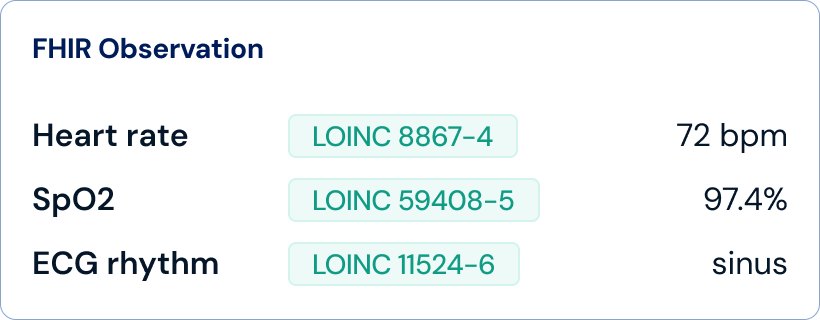
FHIR Observation, LOINC-coded and EHR-ready
Integration is easy, and new devices come onlinewithout release cycles.
Getting on the rails is a few lines of SDK, embedded where your Bluetooth code already runs, alongside your existing stack, no rip-and-replace. And our patent-pending dynamic device provisioning means a new device, especially a continuous one, can come online on the rails without hardcoding its protocol into an app binary or shipping an app-store update. For a team iterating on next-generation hardware, that means new devices and revisions reach care without an engineering release cycle gating every change. Your validated capture doesn't get thrown away; it gets a governed, compliant destination it didn't have.
A few lines of SDK
Embedded where your Bluetooth code already runs, alongside your existing stack, no rip-and-replace.
Dynamic device provisioning
Patent-pending: a new device, especially a continuous one, can come online on the rails.
No app binary, no app-store update
Without hardcoding its protocol into an app binary or shipping an app-store update.
No release cycle gating changes
New devices and revisions reach care without an engineering release cycle gating every change.
Your models get a registry, not a folder.
Algorithms, SaMD and DSP modules live in your organization's own registry on the platform. Each one is versioned, hashed on upload, and turned on or off per program, so a new version is a deliberate act rather than a redeploy. Nothing is shared across organizations, and nothing runs until you enable it.
Versioned
One entry per name and version, and the pair has to be unique. Publishing a new version never silently replaces the one already running.
Verified on upload
Every artifact is hashed when it lands. DSP modules go further: the binary is signed, and an unsigned module is refused unless you explicitly allow it.
Enabled per program
Enable, disable, or activate a version against a given episode type. A model that is not enabled does not execute.
Carried to the record
The observation your model produces names the version that produced it, so a result a year old still points at the exact code behind it.
The last one is the one that matters in a regulated setting. Being able to say which version of which algorithm produced a given value, long after the fact, is the difference between an output a reviewer can rely on and one they have to take on trust.
ReflectProprietary models on the rails, in production.
Reflect is building skin intelligence, predicting and preventing breakouts by understanding how skin changes over time. Skin data is complex, deeply personal, and requires privacy-first handling from the start. Using AnyBio, Reflect uploaded their proprietary ML models, ran them on AnyBio-structured image data, and integrated the SDK, without standing up the regulated pipeline themselves. Their models run on the rails in production today, through the same mechanism described above.

“Couldn't I just build the path myself now?”
The code was never the hard part, and it's less so every month. What you can't generate is the part that takes the year and the trust: being the accountable, audited, governed layer a hospital will actually let near its patients' data, and the place your technology can run on it to reach them.
Scaffold a pipeline in an afternoon. The code gets cheaper every month, and it's not really what you'd be buying anyway.
Sign the BAA, hold the PHI, carry the compliance accountability for the data, produce the audit trail, or be the party a hospital trusts to govern it. That accountability doesn't get cheaper as AI gets better.
What you'd be joining is the rails the providers are on. That's the part you can't build alone: the network on the other side.
The honest boundary.
If owning the entire closed clinical experience, hardware, care delivery and all, is your strategy, build the whole stack. If getting your technology used widely, reaching the teams deploying care without becoming a data-and-compliance company, is what you want, the neutral rails are how. And if you're still validating, with no clinical path yet, the study channel above is likely your entry; the distribution comes as your technology matures on the same rails.
We believe the next generation of care runs on continuous, governed signal, and the devices and models being built now are how we get there. (Our public FDA RFI position argues for continuous device endpoints in next-generation trials; this is the same conviction, built into a platform.)
Put your device or your model on the rails.
Whether it's ready for clinical programs or still being proven through a study, we'll walk through how it gets on the rails, how integration works, and which path fits where you are.